AI-Accelerated Software Engineering
Creation insulated in our network, human-curated promotion into yours, a reusable library behind both, and signed evidence that the controls held.
Overview
Creating software that fits one organisation exactly used to cost more than configuring a product that nearly does. That is no longer true, and the reason is a change in the production method rather than a change in the product.
A small team drives an environment that ingests the material you already have, maintains a structured canon of glossary, domain model, requirements, architecture and design, generates a complete working twin of the system, and promotes only curated, reviewed components into your repository. The expensive part of delivery, turning a corpus of requirements into reviewed, tested, deployable code, stops being done by a large team writing by hand.
The risk in AI-assisted delivery is not that models write poor code. It is that the volume of output exceeds the capacity to review it, and unreviewed code is unowned code. A policy telling developers to review AI output is a weak control, because it asks an individual to restrain a process built for speed. Ours is structural instead: creation and curation happen in different places, under different controls, and the boundary between them is a network boundary rather than a guideline.
Where the work happens
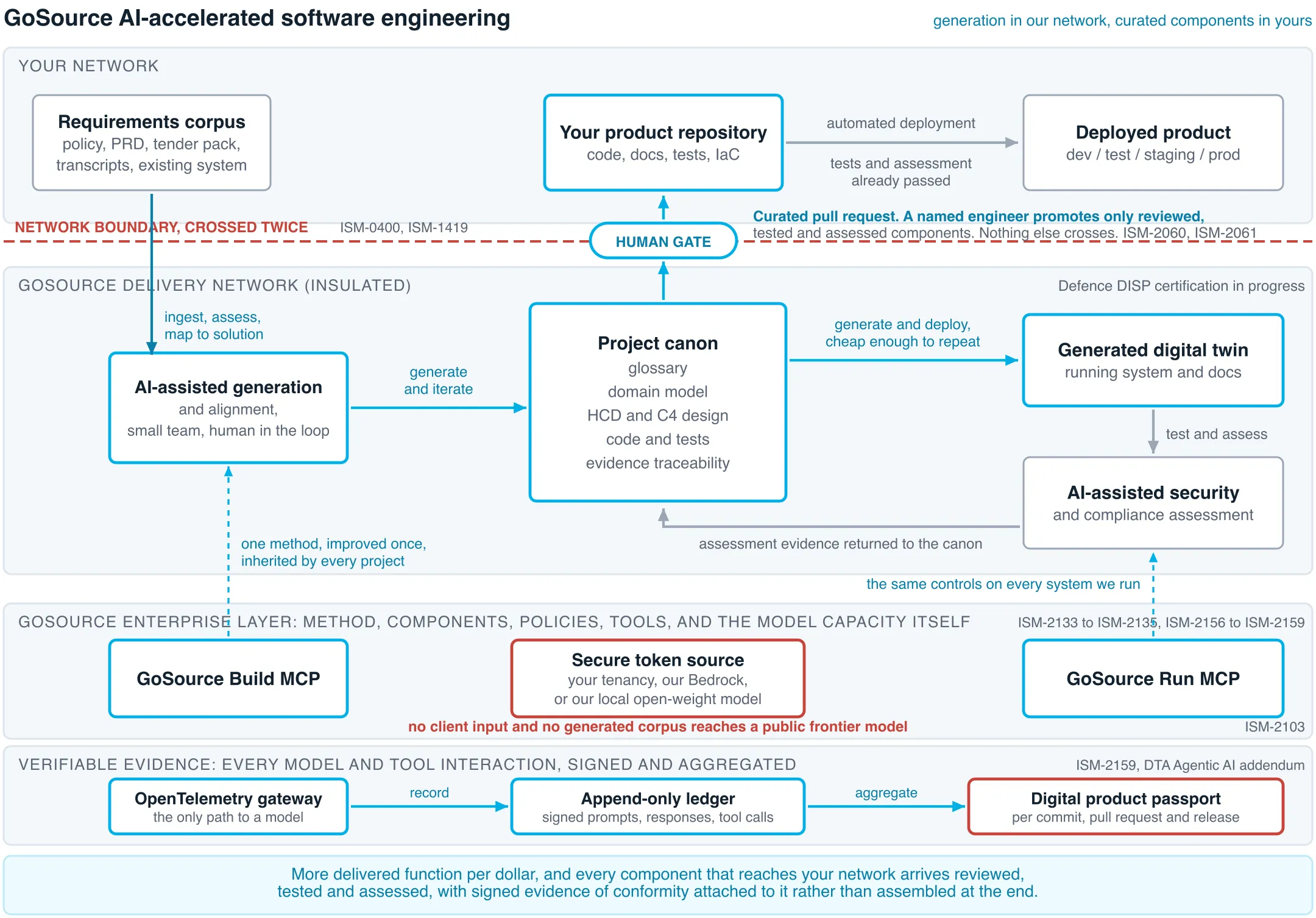
Your network holds three things: the requirements corpus you already have, your product repository, and your deployed environments. Nothing else about how you operate software changes.
Our delivery network holds the work, inside a GoSource-controlled environment undergoing Defence Industry Security Program certification. Generation is cheap enough to do early and repeat, which moves the conversation with your business owners from reviewing documents to using software.
The boundary between the two is crossed twice and by nothing else. Your corpus comes down. Curated components go up. There is no write path from our environment into yours.
A named engineer, every time
A component leaves the twin for your repository as a pull request raised by a GoSource engineer who has read it, understood it and will answer for it. That is the only route in.
Each component arrives carrying test coverage, a security assessment, conformance against the standards that apply to your environment, and traceability to the requirement that produced it. These are properties it holds when it crosses, not gates your team has to apply afterwards.
The rate of promotion is deliberately far lower than the rate of generation. Most output is iteration, explored and discarded, and none of it reaches you. AI accelerates engineering; it does not replace professional judgement.
A library, not a blank prompt
A model working from a blank prompt produces plausible software rather than conforming software, and the distance between the two is paid for in review cycles. What closes it is what the model is given to work from.
We hold a curated library of capability specifications, architectural patterns, engineering skills, reusable components, accessibility and test standards, and operational practice. Projects do not keep their own copy of it; they consult it as a service while the work is created.
So the same controls reach every project rather than only those whose lead applied them. When we harden a pattern, or a standard changes, the change is made once and every project inherits it, including one already running for you.
Evidence you can verify
A control you cannot check after the fact is a control you have to take on trust.
Every interaction with a model or a tool runs through a gateway, and nothing reaches a model except through it. The gateway records each prompt, response and tool invocation with the identity behind it, signed, to an append-only store. Those records aggregate at the commit, the pull request and the release into a digital product passport issued with the software.
That makes conformance something you verify rather than something we assert, after the fact, without access to our systems. Because the passport attaches to the release rather than to our tooling, it survives a change of supplier.
Your material is never used to train a model
Model calls run through a token source chosen to match your policy: a public frontier model under enterprise terms where your policy allows it, our cloud tenancy, your own account, or an open-weight model we host in isolation where classification requires that nothing leaves a controlled environment. Named region and tenancy in every case, and terms that exclude training, fine-tuning or model improvement on your material under all four.
Built to the control framework
AI-assisted development is not a gap in the Australian Government control framework. The Information Security Manual guidelines for software development apply to “human, artificial intelligence (AI)-assisted, AI-powered and AI-driven software development activities”, and state that where they refer to software developers “they apply to humans and AI”. The September 2026 release added controls for agentic applications, and the Digital Transformation Agency published an agentic AI addendum to the AI Technical Standard in June 2026.
We build to those controls: segregated environments, peer and code review on critical and security-related components, automated testing with static and dynamic security analysis before each release, and a software bill of materials delivered with the component rather than assembled on request at the end.